As soon as Transparência Brasil’s Excelências project went live on August 1, 2006, O Globo used its data in a story published in the hot topics section of its newspaper. The article indicated which federal deputies were running for re-election in Rio de Janeiro and were facing legal proceedings or had been convicted. The day after the story was published, Marcelo Soares, a journalist and former editor of the project, received a phone call from a Rio de Janeiro congressman in tears.
The congressman’s record on Excelências indicated that he had been convicted of an electoral crime. According to the politician, the Superior Electoral Court (TSE) prosecuted him for campaigning in a public building and ordered him to pay four basic food baskets. When he paid the fine, he asked the TSE to remove the conviction from his record. “Over the next two weeks, twenty more deputies called me saying that they had paid their fines and that I could now remove [the information that] they were being prosecuted,” says Soares.
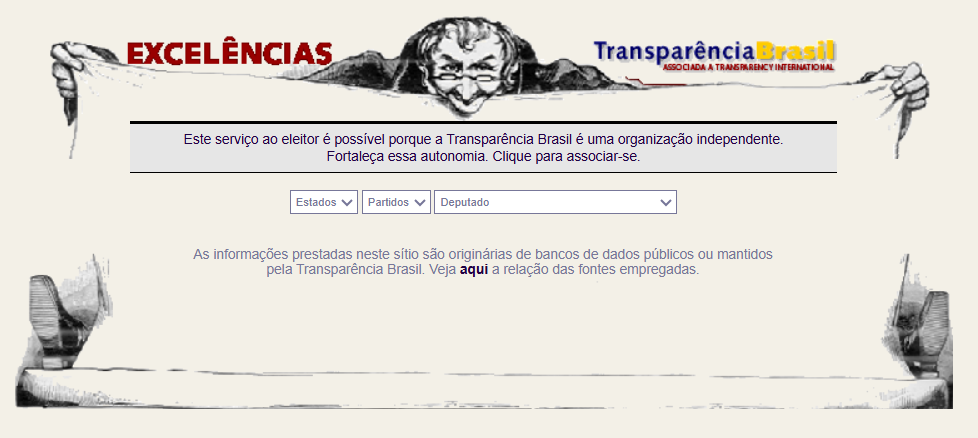
Initial page of Transparência Brasil’s Excelências project when it was launched in 2006. (Photo: Reproduction)
The Excelências platform provided “files” with profiles of active politicians. The data included accountability and electoral financing, involvement in corruption reported in the press, and legal proceedings to which they were liable or for which they had been convicted. When it was launched, the project provided information about the federal deputies running for re-election in 2006.
At the time, following the Mensalão and ambulance mafia scandals, Brazilian society was particularly interested in the backgrounds of parliamentarians. “The whole population was looking at politicians in a supervisory way and demanding their work. All the scandals were multi-party, with the same structure and format,” recalls Soares.
TB’s aim with Excelências was to aggregate, make available and keep up to date as much information as possible about the parliamentarians in office – a costly job of research and information construction. Access to cases in the more than 100 courts of justice and accounts, for example, depended on manual and individual consultation.
Data was collected manually from at least five public sources. Two other TB projects were also used as sources: press mentions of parliamentarians in corruption cases gathered by Deu no Jornal, and electoral financing data organized by Às Claras.
By adding different data to its base, Excelências built up new information that made it possible to understand the profile of parliamentarians, generating concrete data on the state of corruption in Brazilian politics.
It took the team around three weeks to get the platform up and running before the 2006 elections. Soon after its launch, the project was marked by its pioneering role in parliamentary transparency.
In the first few months of work, the initiative was widely celebrated and used as a source of data by the press. Its public contribution was irrefutable and for this reason it received the Esso Award for Best Contribution to the Press in December 2006. Until then, the only dissatisfaction with the project came from parliamentarians who wanted to present their versions of the cases they were answering or had been convicted of.
Over time, the Excelências database was expanded to include as many elected politicians as possible and information associated with parliamentarians. In 2008, the project made available the records of 2,362 politicians, ranging from the federal legislature to the municipal legislature in the capitals, whose data included attendance at plenary sessions, changes in assets and the closeness of parliamentarians to interest groups, among others.
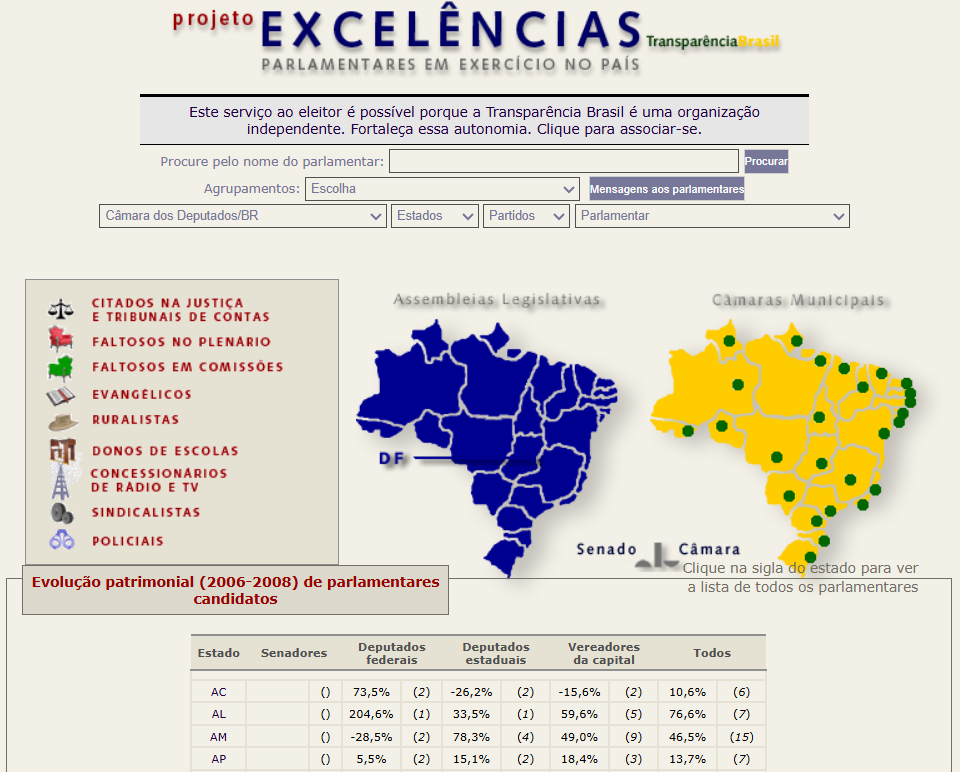
Home page of Transparência Brasil’s Excelências project in 2008 (Photo: Reproduction)
Another of the project’s contributions to the public debate was the construction, in 2008, of an overview of the transparency given to information by legislative houses, state Courts of Justice and Courts of Auditors. In November 2008, for example, 21 of the country’s 27 Legislative Assemblies did not disclose any data on the compensation paid to state deputies.
The bodies were not obliged to follow any rules to publicize their data and, as a result, the population was prevented from knowing how they carried out their work. This scenario only changed later, with the Access to Information Law – whose coverage at all levels and spheres of power was guaranteed by TB’s efforts.
By working with irrefutable public data, Excelências was a source for the press from the day it was launched until the end of the project in 2017. Most of this period was under the command of former director Cláudio Weber Abramo. The media consulted the platform and reported on TB’s analyses, such as the use of compensation funds by parliamentarians.
For Fabiano Angélico, TB’s former project coordinator, it was the combination of the great repercussions in the press and the use of public information that caused great impact – and discomfort – among parliamentarians and magistrates.
Former councillor Teresa Bergher (PSDB-RJ) is among the politicians who have sued members of the TB team for offending their honor due to information published in Excelências. In December 2009, Judge Marcio Lucio Falavigna Sauandag of the Special Criminal Court of São Paulo rejected the lawsuit. His decision states that “the source of the offenses, the malicious website, simply carries information, of a public nature […]”. Other parliamentarians have also sued the organization, but none have been successful.
“Many MPs and councillors called saying we had to take it down [the information]. We said: we’re giving the link to the court, we’re not making anything up. And they would reply that it was just an accusation, but that was exactly what we were reporting. There were some who would personally visit our headquarters,” says Angélico.
The reaction of some parliamentarians led to the addition to the Excelências files of the politicians’ version of the electoral processes they were answering or for which they had been convicted, since the details of these processes were not public. On the other hand, other parliamentarians voluntarily wanted to expose their data on the platform, which exemplifies the project’s relevance to society and the press.
Although he only used public information, Marcelo Soares says it was impressive how uncontroversial Excelências was at first, even among politicians. “We thought we’d be prosecuted straight away,” recalls the former editor of the project, “but when the Ficha Limpa law came into force, this started to put the mandate of parliamentarians at risk.”
The Ficha Limpa bill (PL Complementar nº 518/09) was born in 2009 from the popular initiative of 1.6 million citizens moved by the Ficha Limpa Campaign of the Movement to Combat Electoral Corruption. The PLP was approved by the House of Representatives and the Senate in May 2009, and Complementary Law No. 135/2010 was sanctioned by the President of the Republic in June 2010.
June 2025 marked the 15th anniversary of one of the most important pieces of legislation for the integrity of elections in the country. The Ficha Limpa Law established rules to bar the candidacies of politicians convicted by the decision of a collegiate body, as well as classifying which crimes constitute ineligibility.
Previously, those convicted of serious crimes could stand for election while appealing their conviction. Due to the slowness of the judicial process up until the final decision, their candidacy was only challenged long after their term of office had expired.
For former TB project coordinator Fabiano Angélico, Excelências contributed to the public debate that led to the legislation, as it made it possible to know precisely and easily which politicians were involved in corruption and other crimes.
It was the project, for example, that made it possible to identify that 58% of the senators who voted to impeach former president Dilma Rousseff (PT) in 2016 were being prosecuted for administrative improbity and passive corruption.
Excelências is a pioneering work in the manual construction of information about the Brazilian parliament. Its complexity highlights TB’s commitment, over the last 25 years, to disseminating public data and creating monitoring tools for the population.
Today, other initiatives comprise only part of the information that was collected, analyzed and updated daily by the project. TB does not maintain the Excelências database, but the demand for its data remains to this day.