It’s February 29, 2000. A group of individuals are meeting in São Paulo. Notable in their fields, they represent various sectors of civil society, from professors to businessmen, journalists, magistrates and prosecutors. They share a common concern: the timidity of the measures taken by public authorities and control bodies to combat corruption in Brazil, whose cases dominate the headlines.
Transparência Brasil was founded a month after that meeting, with the mission of fighting the roots of corruption in the country in order to promote systemic changes, improve the quality and efficiency of public spending and strengthen democracy. The purpose continues to drive the organization: “Our goal is to make institutions work better and that this leads to a healthier relationship between the population and public authorities,” emphasizes Eduardo Capobianco, one of the founding members and president of TB’s Board of Directors.
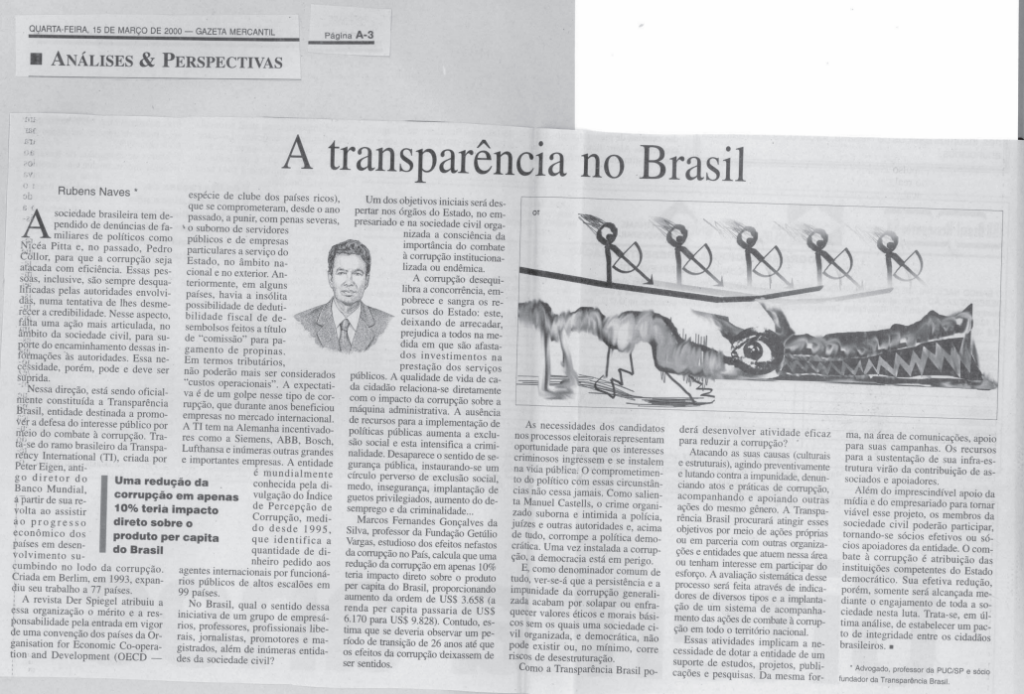
Announcement of the founding of Transparência Brasil in an article by Rubens Naves, one of the organization’s founding members, published in the newspaper Gazeta Mercantil on 15.Mar.2000.
The anti-corruption movement that was expanding in the 1990s, with the emergence of international bodies and organizations, inspired the creation of the organization. According to Capobianco, this global mobilization was based on legislation and measures aimed at Europe and North America, such as the Convention on Combating Bribery of Foreign Public Officials in International Business Transactions of the Organization for Economic Cooperation and Development (OECD) in 1997.
When establishing Transparência Brasil, the 33 founders sought a national approach to the issue. “Our concern was internal, based on important issues happening in Brazil, […] because the causes [of corruption] were different from those in other countries, especially developed ones,” says the businessman. From 2000 to 2007, TB represented Transparency International (TI) in the country.
Capobianco recalls that internal corruption issues only came to light with the then recent return to democracy and the end of the civil-military dictatorship. For him, “democracy has brought to light things that could not be talked about in the past”, bringing to the surface problems that began under the regime of exception and that should be dealt with through systemic changes.
At the time, anti-corruption measures were adopted mainly by the Public Prosecutor’s Office, which acted mainly in reaction to scandals revealed by the press, as in the cases of Fernando Collor and the Budget Dwarfs, according to lawyer Rubens Naves, also a founding partner and current member of the Board of Directors.
“The situation was one of big, one-off scandals and an inefficient response from the public authorities and control bodies, such as the courts of auditors,” says Naves. For the lawyer, the creation of Transparência Brasil arose from civil society’s concern about the lack of articulated action to combat corruption in the country.
In order to transform the scenario and promote the improvement of institutions, TB adopted, in a pioneering way in Brazil, the collection, analysis and dissemination of public data as its main methodologies, as well as the development of mechanisms for social supervision and monitoring.
The way it works and its technical rigor have consolidated TB as a source of qualified knowledge for society and the press, as well as for public authorities. At the beginning of its work, the organization met with then President Fernando Henrique Cardoso to involve the government in an articulated movement to fight corruption.
Subsequently, the presidential candidates in 2002 signed a letter of commitment to improving state mechanisms to fight corruption, presented by TB.
“Unfortunately, the dialog we thought this document would provide between the government and civil society didn’t happen. We were ignored for a long time, and then we had to take a more critical attitude towards the federal executive at the time,” recalls Rubens Naves.
The legacy
“What is the point of this initiative (…)?”, asks Naves in an article announcing the creation of Transparência Brasil on 15.Mar.2000 in Gazeta Mercantil.
After twenty-five years, he answers: with the organization, a set of ideas about fighting corruption has been transformed into systematized action. “Corruption is an international phenomenon, but the experiences of fighting it are very rich and diverse. TB brought this complexity to Brazil and the dialog deepened. This is a great legacy,” he says.
For Eduardo Capobianco, TB’s aim of creating mechanisms that facilitate access and social control by society and the press has remained throughout the years. He says that the organization works on issues that vary according to the situation in Brazilian society, but it persists in improving institutions to reduce the windows for deviations and inefficiency in public power.
The founders
The 33 founders of Transparência Brasil who made it possible to build this legacy are:
- Aristides Junqueira Alvarenga
- Bruno Wilhelm Speck
- Claudia Souza de Murayama
- David Fleischer
- Denise Frossard
- Dyrceu Aguiar Dias Cintra Junior
- Edson Luiz Vismona
- Eduardo Ribeiro Capobianco
- Elizabeth Sussekind
- Fernando Celso Garcia de Freitas
- Fernando Cláudio Antunes Araújo
- Francisco Whitaker Ferreira
- Guilherme Amorim Campos da Silva
- Iradj Roberto Eghrari
- Jerry Greene
- Jorge Luiz Numa Abrahão
- José Alves de Sena
- José Carlos Amaral Kfouri
- José Mauro Gomes
- Kenarick Boujikian Felippe
- Ladislau Dowbor
- Luiz Pedone
- Marcos Fernandes Gonçalves da Silva
- Modesto Souza Barros Carvalhosa
- Neissan Monadjem
- Nilson Seizo Kobayashi
- Oded Grajew
- Ricardo Young Silva
- Rogério Pacheco Jordão
- Rubens Naves
- Sergio Hadad
- Sergio Storch
- Vitor Morgensztern