The number of falls from train stations in São Paulo has fallen after Agência Muralrevealed the number of accidents per year,based on data obtained via the Access to Information Act (LAI). The average number of falls per year fell from 1,000 in 2017 to 300 in 2023, illustrating how legislation enhances journalistic work and its impact on people’s lives.
This May marks thirteen years of reporting like this, made possible by the LAI‘s guarantee that access to information and public transparency are obligations of the three branches of government in all spheres of the country. This scope is the result of Transparência Brasil’s tireless efforts, between 2005 and 2009, to alert partner organizations and the federal government to the urgency of legislation that would mainly reach those most reluctant to be accountable to society.
There was a long road between the beginning of civil society’s demand for legislation and the presidential sanction of Law 12.527/2011 on November 18, 2011, and its entry into force on May 16, 2012. Bill 219/2003, by federal deputy Reginaldo Lopes (PT-MG) was the first to propose rules for what is stated in Article 5, item 33, of the Federal Constitution: “everyone has the right to receive from public bodies information of their particular interest, or of collective or general interest”.
In 2005, Transparência Brasil raised the need to advance the regulation of access to information in the country within the Public Transparency and Anti-Corruption Council (CTPCC), a body linked to the Office of the Comptroller General (CGU) and today called the Transparency, Integrity and Anti-Corruption Council. The federal government presented a draft bill the following year:
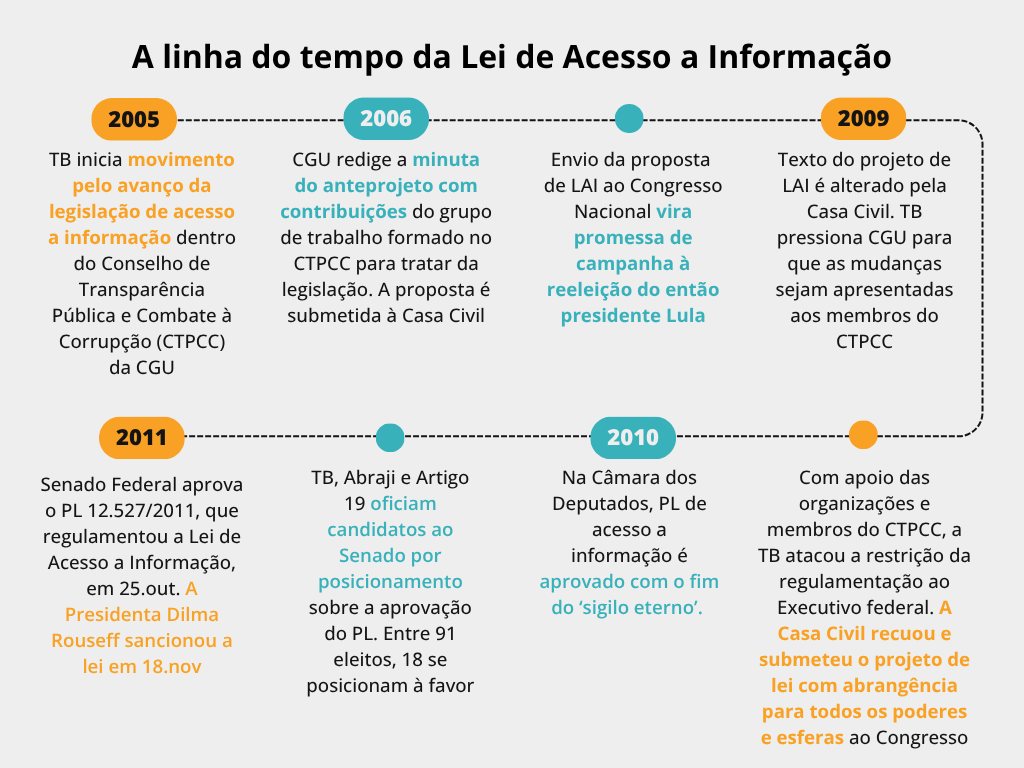
Timeline of Transparência Brasil’s actions for the approval of the Access to Information Law covering all levels and spheres of government
Cláudio Weber Abramo (1946-2018), executive director of TB at the time, recounted in an article in Observatório da Imprensa the organization’s essential role in getting the legislation passed and applicable to all levels and powers.
During the 2006 presidential elections, for example, Transparência Brasil secured a commitment from then-president Lula to send the draft to Congress the following year if he was re-elected. According to Abramo, the president made this promise publicly at least three times. From 2007 to 2008, the organization reacted to the federal government’s silence: it sent several requests for clarification to the Civil House and the CGU about the Executive’s inertia.
At the beginning of 2009, the press reported that the draft bill, amended by the Presidency of the Republic, would finally be put on the agenda. TB put pressure on the CGU to present the new text to the CTPCC and obtained broad support from other entities in the body. Faced with the government’s proposed ‘disaster’ of restricting the regulation of access to information to the federal executive, the organization fought a battle to reformulate the text.
Transparência Brasil attacked the exclusion of state and municipal bodies from the project. As Abraji’s 2008 Access Mapshowed , they responded very poorly to demands for information: only the City Council of two municipalities and one city hall provided information requested by the organization on the basis of Article 5, item 33, of the Constitution. The same survey carried out the previous year with 120 state bodies from the three branches of government indicated that only 5.8% provided information.
According to the former TB director, the ‘absurdity’ of the Presidency’s proposal was duly recognized by the civil organizations of the CTPCC and by the representative of the Ministry of Finance José Mauro Gomes on the Council, as well as by the CGU. The reformulated text removed the restriction of the legislation to the federal executive and was sent to the Chamber of Deputies in 2009.
Congressmen and women approved the bill on April 13, 2010, with important changes to the period for classifying documents as secret, which until then had been unlimited. While the bill was being processed in the Senate, Transparência Brasil asked the House candidates for a position on the bill.
With the support of Article 19 and Abraji, 91 Senate candidates with more than 10% of voting intentions in the polls were contacted. Of those elected, only 18 committed to approving the bill.
The Access to Information Law was approved by the House two years after it was presented to Congress by the federal government, on October 25, 2011. The senators kept the text that came out of the House, whose classifications of secrecy are limited, despite efforts to restore eternal secrecy on documents, proposed by the substitute of then senator Fernando Collor de Mello.
Challenges to full access to information remain after legislation
One year into the LAI, the scenario was one of a lack of an adequate structure for bodies to open requests and respond to them. At the time, Cláudio Weber Abramo considered that there was a generalized classification of documents as confidential as a way of maintaining opacity over information of public interest – which is still the case today.
According to TB’s program director and access to information specialist, Marina Atoji, the LAI established a list of minimum information to be disclosed, but some procedures, such as appeals and classification of secrecy, do not work fully when there are no regulations for that level or sphere of power.
From the entry into force of the LAI until today, there has been a persistent resistance on the part of public authorities to regulating it and adapting to good transparency practices. IBGE data indicated that 45% of Brazilian municipalities had still not created their own regulations after seven years of legislation.
Atoji says that the inertia in taking steps in this direction is one of the symptoms of the lack of importance given to the right of access to information. In addition, it is still a characteristic of public authorities to avoid the headache of providing information about their management and operations. “There is no incentive to implement the LAI properly and no disincentive to disobey it. Not complying with the LAI is still cheap,” says TB’s program director.
The challenges to regulation motivated the organizations that make up the Forum on the Right of Access to Public Information, including Transparência Brasil, and the Rio Institute for Technology and Society to promote the Regulamenta LAI campaign in municipalities in 2020. The initiative worked through the creation and presentation of popular initiative bills.
For TB’s program director, Marina Atoji, the understanding that there is a clear set of rules that citizens can ask for any kind of information and that the government has an obligation to respond within a specific timeframe needs to be popularized in society and in the civil service.
“Access to information strengthens democracy because it brings citizens closer to public authorities. There is a duty of responsiveness and an obligation for the state to be accountable to you. And this is your right. It’s there to talk to you,” he says.
As for journalism, Atoji says that the LAI ‘is a declaration of independence’, because the profession no longer depends on press offices and the goodwill of public authorities to comply with Article 5 of the Constitution and provide information.
For the last five years, TB has been working to ensure that the legislation is complied with in all spheres and powers, guaranteeing the journalistic function of disseminating public information in a way that is accessible to society – the organization’s purpose since it was founded.
The Findings and Requestsproject , for example, carried out together with Abraji, brings together requests and responses from agencies via the LAI, questions and tips on how to request information. As it is an extensive online repository, journalists and citizens can search for data already provided by public authorities.
In addition, TB produces qualified knowledge about access to information, maps challenges and gaps in the area, such as the inappropriate use of the General Data Protection Law to deny public information, and contributes to strengthening the monitoring activities of the Access Forum.