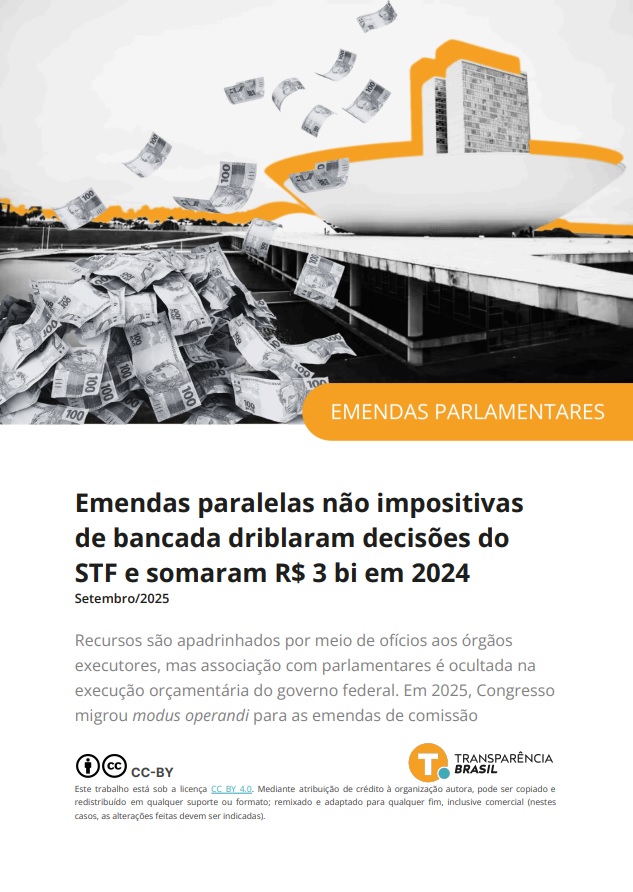
Last Thursday, January 15, Minister Flávio Dino of the Federal Supreme Court (STF) ordered that the execution of parliamentary amendments by Codevasf and Dnocs be regulated. The decision came after Transparência Brasil complained to the minister that Codevasf was the preferred destination for “parallel” bench amendments.
Known as the “state-owned company of the Centrão”, Codevasf (Companhia de Desenvolvimento dos Vales do São Francisco e do Parnaíba) had its budget boosted by R$408.3 million in “parallel” bench amendments in 2024, according to a survey by TB. Of this amount, R$313.7 million is traceable.
The “parallel” bench amendments are identified with codes RP 2 and RP 3, referring to non-mandatory federal government spending that does not involve parliamentary amendments and expenses linked to the PAC. When they are executed, they are mixed in with other expenses and are no longer associated with parliamentarians. In total, from 2020 to 2025, Congress inserted R$9.4 billion of this type of amendment into the federal budget.
The caucuses – and the parliamentarians who are part of them – indicate where the funds from the parallel amendments will go by sending letters to the top level of the federal executive. In the case of Codevasf, TB revealed that deputies and senators addressed the president of the state-owned company directly and used expressions such as “my quota” and “credit bearer”, even indicating the contact details of community associations that were to receive high-cost goods purchased by the company, such as backhoes.
The case was denounced by TB, Contas Abertas and Transparência Internacional – Brasil to the STF in July 2025, in the context of ADPF 854, in which the organizations act as amici curiae. In the letter, the organizations pointed out that the “parallel” bench amendments did not comply with the STF’s demands for total transparency and traceability, since it was not possible to detail how 61% of the funds were spent, nor to know who the parliamentarians were who indicated them.
In the decision of January 15, 2026, Dino stated the need to regulate the execution of the amendments directed to Codevasf and Dnocs in the face of “chronic problems, in disproportion to other areas of the government”. The ministries of Regional Development and Management and Innovation and the Comptroller General of the Union (CGU) have 60 calendar days to present the technical note.