28/09/2026
Women of color face a double disadvantage in the race for federal, state, and district congressional seats in 2026, according to an analysis by Transparência Brasil released this Saturday (Sept. 26, 2026) in the second edition of the “Caixa de Campanha” newsletter. This group is underrepresented among candidates relative to its share of the population and receives a smaller share of public campaign funds than the total pool of candidates. The survey was based on official data from the Superior Electoral Court (TSE) updated as of Sept. 22, 2026.
Women of mixed race are the most underrepresented group in the electoral race: they account for 22.7% of the population, represent only 12.2% of the candidates, and received just 10.5% of public campaign funds — meaning they were allocated R$67 million less than their share of the candidate pool would warrant.
White men are doubly favored. They make up 20.4% of the population but account for 33.5% of the candidates and received 40.5% of public funds, which corresponds to R$ 289.1 million in overfunding.
White women are underrepresented among candidates (16.7% compared to their share of the population), but received overfunding (20.7% of public funds) totaling R$ 162.1 million.
Black men (7.4% of applications) and mixed-race men (22.6%) are the groups with the highest proportional underfunding: they received, respectively, 3.9% and 17.5% of public funds, which amounts to R$ 141.4 million and R$ 209.6 million less. Unlike mixed-race women, these groups are not underrepresented among candidates relative to the population.
In the 2026 general elections, political parties are required to allocate public funds proportionally to candidates who are women and Indigenous people and to set aside at least 30% of the funds for candidates who are Black (Black and brown-skinned). However, the minimum 30% quota for female candidates applies only to proportional representation seats, and the quota for resource distribution is not restricted to proportional representation seats. Furthermore, parties have the autonomy to distribute resources according to their own strategies and interests. Thus, the “underfunding” observed for certain groups does not necessarily imply that parties are in violation of electoral regulations.
Differences Among Parties
Black and mixed-race male and female candidates are underfunded in most parties. Of the 26 parties that reported the distribution of public funds as of September 22, 2026:
- 23 underfunded Black men and 22 underfunded mixed-race men;
- 19 underfunded Black women and 16 underfunded Brown women.
The analysis by party uses a proportionality index adapted from the study “Quem ganha mais” (Mardegan et al., FGV Direito SP, 2026), which compares the percentage of funds received by each group with its percentage of the total number of candidates.
Campaign Fund
“Campaign Fund” tracks inequality in the financing of proportional representation candidates in the 2026 general elections. It is a product of Transparência Brasil’s Party Transparency program, supported by the Galo da Manhã Institute.
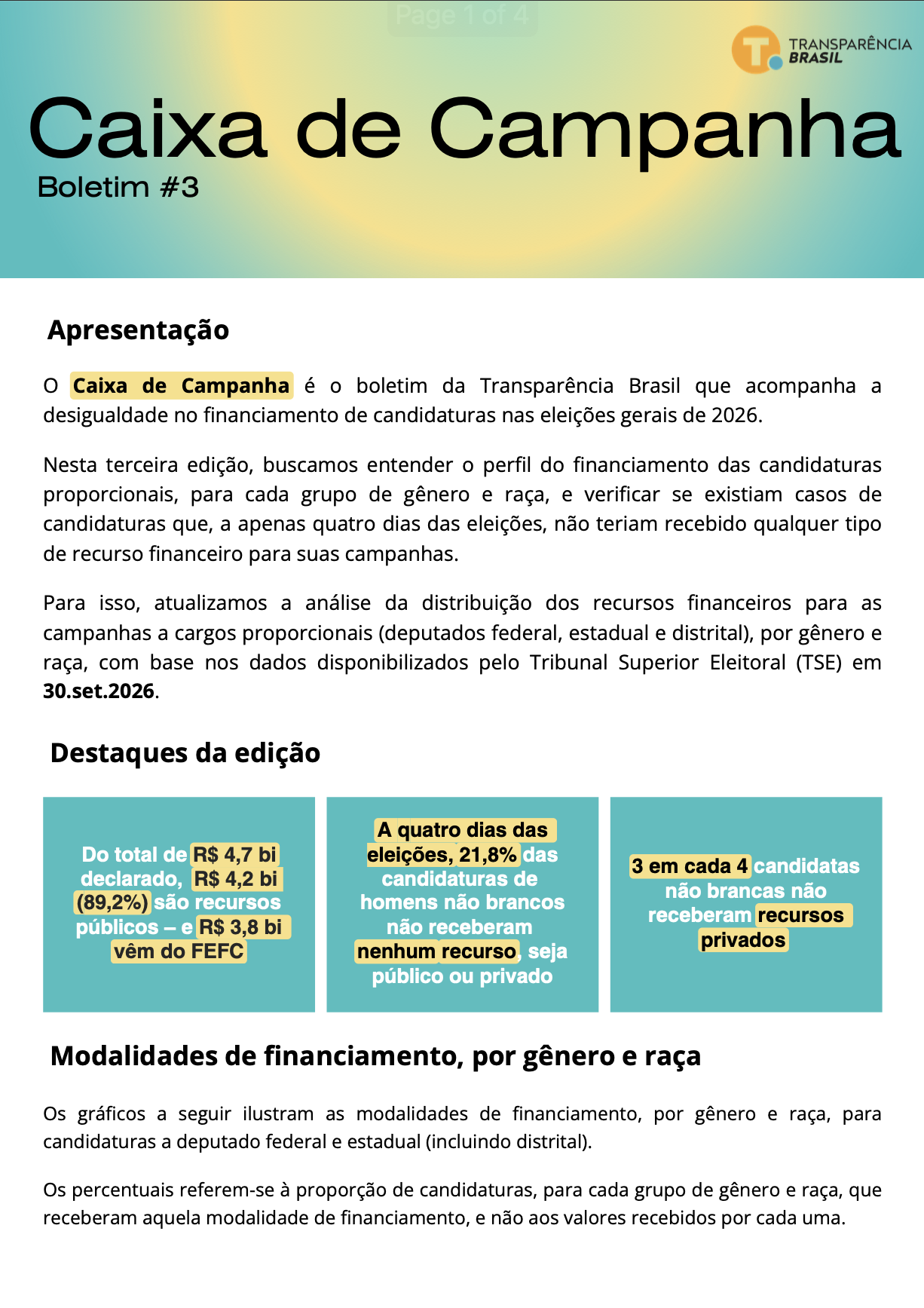
The first bulletin was released on Tuesday (Sept. 22), with data updated through Sept. 15, 2026, and compared the percentage of funds received by each group with its share of the total number of candidates. Non-white candidates (Black, Indigenous, and Asian) for federal, state, and district representative positions account for 49.8% of all candidates but received only 39.6% of the public funds distributed by the parties. Proportionally, they were shorted R$ 394 million at that time.
The second bulletin details the funding for each group. Of the total R$ 4.5 billion in financial resources declared as of September 22,2026 by proportional representation candidates, R$ 4.1 billion (91%) consists of public funds, and R$ 3.8 billion comes from the Special Campaign Financing Fund (FEFC).
Compared to the previous report, the candidates reported more private funding, and the share of public funds in total revenue fell by 1.8 percentage points. Even so, public funds remain the main source of campaign financing.
The report can be accessed at this link.